All Posts - CAKE COOKING RECIPES IDEAS
Pork Ginataan with Squash and String Beans

Pork Ginataan with Squash and String Beans

 Pork Ginataan with Squash and String Beans is a rich and delicious Filipino dish that makes use of pork, coconut milk, and vegetables such as squash and string beans. This recipe has many variations. You can do this with other types of meat and even with seafood such as crab. In fact, Ginataang Sitaw at Kalabasa with Crab is one version that I enjoy eating.

I love this dish because it is very tasty and delicious. The only thing that bothers me is the certainty that I will always overeat when this dish is served because it’s richness and flavor do not deserve just a cup of rice — maybe 2 or just a little bit over it.


Ingredients

1 1/2 lbs. pork cubed

1 1/2 cup beef broth

2 cups coconut milk

1/4 cup shrimp paste bagoong

1 small butternut squash cubed

1 small bundle of string beans cut into 2 inch pieces

1 medium yellow onion sliced

1 1/2 teaspoons minced garlic

3 tablespoons cooking oil

1/4 teaspoon ground black pepper

Salt to taste optional


Instructions

Heat the cooking oil in a cooking pot.

Once the oil gets hot, saute the garlic and onion.

Add the ground black pepper. Stir and then add the pork. Cook the pork until the color turns light brown.

Pour the beef broth in the cooking pot. Let it boil.

Add the coconut milk. Stir and allow to boil once more. Cover and cook in low to medium heat until the pork gets tender.

Add the squash. Stir, cover and cook for 8 to 10 minutes.

Add the shrimp paste. Stir.

Add the string beans. Cover and cook for 3 to 5 minutes. Add salt only if needed.

Transfer to a serving plate. Serve.

Share and enjoy!

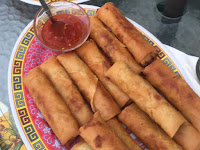
Traditional Filipino Lumpia

Traditional Filipino Lumpia

 “This is a traditional Filipino dish. It is the Filipino version of the egg rolls. It can be served as a side dish or as an appetizer.”


Ingredients

1 tablespoon vegetable oil

1 pound ground pork

2 cloves garlic, crushed

1/2 cup chopped onion

1/2 cup minced carrots

1/2 cup chopped green onions

1/2 cup thinly sliced green cabbage

1 teaspoon ground black pepper

1 teaspoon salt

1 teaspoon garlic powder

1 teaspoon soy sauce

30 lumpia wrappers

2 cups vegetable oil for frying

Directions

Prep : 45  – Cook : 25 m – Ready In : 1 h 10 m


Place a wok or large skillet over high heat, and pour in 1 tablespoon vegetable oil. Cook pork, stirring frequently, until no pink is showing. Remove pork from pan and set aside. Drain grease from pan, leaving a thin coating. Cook garlic and onion in the same pan for 2 minutes. Stir in the cooked pork, carrots, green onions, and cabbage. Season with pepper, salt, garlic powder, and soy sauce. Remove from heat, and set aside until cool enough to handle.

Place three heaping tablespoons of the filling diagonally near one corner of each wrapper, leaving a 1 1/2 inch space at both ends. Fold the side along the length of the filling over the filling, tuck in both ends, and roll neatly. Keep the roll tight as you assemble. Moisten the other side of the wrapper with water to seal the edge. Cover the rolls with plastic wrap to retain moisture.

Heat a heavy skillet over medium heat, add oil to 1/2 inch depth, and heat for 5 minutes. Slide 3 or 4 lumpia into the oil. Fry the rolls for 1 to 2 minutes, until all sides are golden brown. Drain on paper towels. Serve immediately.

SIMPLE SUNDAYS | MECHADO FILIPINO BEEF STEW

SIMPLE SUNDAYS | MECHADO FILIPINO BEEF STEW

 Comfort in the form of a hearty stew can be found in nearly every country’s cuisine, and the Philippines is no different. Mechado, Filipino Beef Stew, is the Philippine’s version of the ubiquitous comfort food with a wonderful depth of flavor that comes from browned garlic, marinated beef, and the complex flavors of patis, or fish sauce.

When I first started dating my husband, our mutual friend clued me in — he’s a “beef and potatoes man,” she said. I knew in an instant that Mechado would be the first dish I would cook for him. In my little apartment, on that tiny little stove, I made my ultimate stick-to-your-ribs comfort dish. It seemed very appropriate for that early autumn day in the midwest, with familiar flavors, no matter where you were from.


INGREDIENTS

▢1 1/2 lbs beef for stew

▢juice of half a lemon

▢1/4 cup good dark soy sauce I like Silver Swan, found in Asian markets

▢freshly ground black pepper to taste

▢3 tablespoons canola oil

▢3 cloves garlic minced or crushed

▢1 medium onion diced

▢1 teaspoon fish sauce (patis)

▢1 cup tomato sauce

▢1 1/2 cups water

▢several dashes of Tabasco

▢2-3 cups beef stock

▢2 bay leaves

▢1 red bell pepper sliced

▢2 russet potatoes peeled and cut into 2 inch chunks

▢2 carrots peeled and chopped in 2 inch pieces

▢kosher salt

▢freshly ground black pepper


INSTRUCTIONS

Marinate beef in soy sauce, lemon, and black pepper for at least 30 minutes.

Brown garlic in oil and set aside.

Brown beef, working in batches if necessary (reserve the marinade).

Return beef to pot, add onions and season with fish sauce (patis).

When the onions are wilted, add tomato sauce and water and stir.

After about two minutes, add Tabasco, beef stock, 2 tablespoons of reserved marinade, bay leaves and bell pepper.

Let come to a boil, then lower heat to simmer. Add reserved garlic. Cover the pot with the lid, and let it stew for about 1 1/2 hours (see notes), stirring occasionally.

When the meat is tender, add potatoes and carrots. Continue cooking until the potatoes are fork tender, about 20 minutes more.

Season with salt and pepper to taste. Serve over rice.

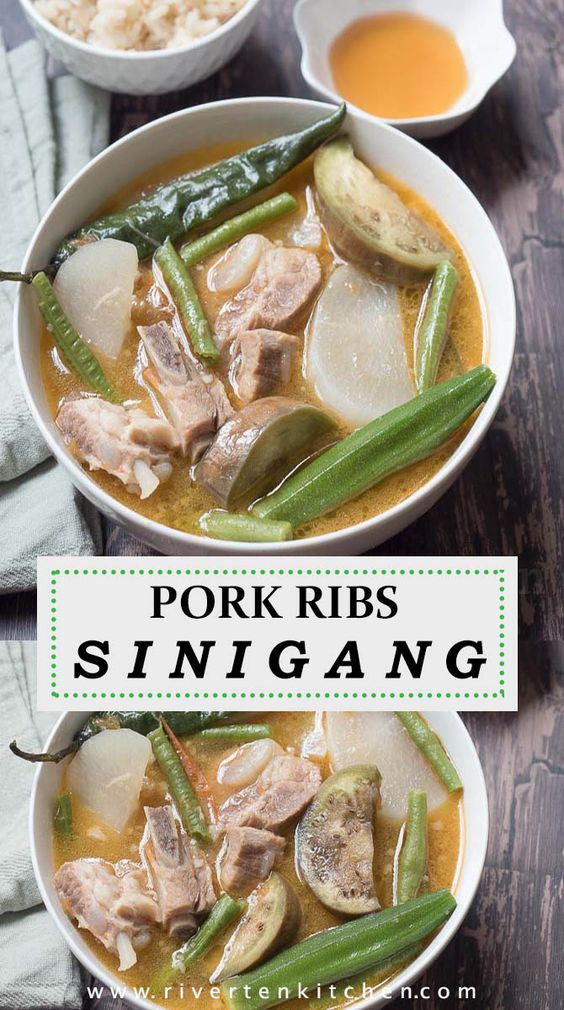
Pork Ribs Sinigang (Sinigang na Baboy)

Pork Ribs Sinigang (Sinigang na Baboy)

 A sinigang recipe made of tender and fall off the bones Pork ribs and classic sinigang vegetables. The broth is blended with shavings of gabi making it rich and deliciously sour. This is your ultimate Filipino comfort food made easy!

Soups that are made of pork ribs are hearty and richer in flavor. It also has lesser fat content compared to pork belly which is a popular cut for sinigang.


Ingredients

1 kg / 2 lbs. pork ribs (washed and strained)

5 cups water (see note 1)

1 medium-size gabi (shaved with a peeler)

1 yellow onion (quartered)

2 tomatoes (quartered)

pieces okra (ends trimmed)

2 green chili (sili pangsigang)

eggplant (cut into 1/2 thick inch)

bunch of green long beans (cut into 3 inch length)

bunch of water spinach (kangkong)

2 tablespoons fish sauce (add more if preferred)

20 gram 1 1/2 tbsp tamarind mix (add more if preferred)

salt to taste


Instructions

Saute garlic, onions. Add the ribs together with the gabi shavings. Stir a bit then pour the fish sauce. Let it cook until juices appear. Pour water and cook for 1 to 2 hours or pressure cook for 20 to 30 minutes.

Add choice of vegetables starting with the radish, cook until tender. Then add the greens like sitaw, eggplant, okra. Let it cook with the lid on until vegetables are half done.

Pour choice of souring agent and cook for 2 to 3 minutes. Then finally add kangkong or choice of leafy greens. Simmer for another minute. Serve with rice and enjoy!

HOW TO MAKE FILIPINO ADOBO

HOW TO MAKE FILIPINO ADOBO

 Filipino Adobo is one of the most famous Filipino food in which foreigners are curious about. It has few ingredients which are readily available. If you try your hand in making Adobo, you can use your favorite meat like chicken, pork and beef and for myself, I even used Salmon.

In the video below, you will see how easy it is to make our famous Filipino Adobo. I tried my hardest in showing you how to cook our this staple Filipino food, the easy way.

In my post way back 2015, I made a Slow Cooked Adobo in which I used Chicken Drumsticks; this time, however, I opted for chicken wingettes because it has become my favorite lately. It feels like chicken wingettes has more tastes compared to chicken drumstick. I thick it is because of wingettes has more fat,maybe?


Ingredients

3 lbs chicken wingettes

½ cup largely chopped onion

1 clove garlic

½ cup soy sauce

¼ cup vinegar

1//2 tablespoon salt

1 cup water

3 or more bay leave

⅛ cup brown sugar

4 or more boiled eggs (optional)

2 tablespoons cooking oil


Instructions

Heat oil in a large cooking pan and saute' the garlic and the onion.

When garlic is brown and onion is transparent, add the chicken wingettes and cook until change in color - color brown or until pale. Cook in a low heat, with the pan covered.

When chicken meat is ready, add in water. Cook chicken until soft and add in more water if needed.

When chicken is soft, add the soy sauce, vinegar and salt. Cook some more for 5 minutes to let the sauce absorb and then add the bay leaves and sugar.Continue cooking for 5 more minutes and then add the boiled egg. You can add more water if you want more sauce for your Adobo and just adjust the taste according to your liking. The end result should be a sauce with a bit of saltiness and hint of sour- ness.

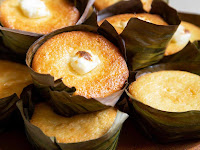
BIBINGKA (COCONUT RICE CAKE)

BIBINGKA (COCONUT RICE CAKE)

 Soft and fluffy bibingka baked in banana leaf lined muffin tins. This is an easy homemade version of the popular Filipino coconut rice cake traditionally cooked in clay pots.

October is Filipino American History Month (FAHS). The first Filipinos arrived near what is now Morro Bay, California back in October 18, 1587 aboard a Spanish ship. (YES. They arrived 33 years before the English Pilgrims landed at Plymouth Rock!)


INGREDIENTS

frozen banana leaves, as needed to line molds or tins

melted unsalted butter, for brushing

180 grams rice flour*

45 grams all-purpose flour

24 grams (2 Tablespoon) baking powder

1/4 teaspoon kosher salt

4 large eggs, room temp

300 grams granulated sugar

13.5 oz can full-fat coconut milk, well-shaken

57 grams unsalted butter, melted

block cream cheese, thinly sliced, as needed for topping


INSTRUCTIONS

Thaw frozen banana leaves at room temperature. Or, quickly thaw them under cool running water. Rinse banana leaves to remove any dirt or dust. Pat dry with paper towel or cloth kitchen towel.

If necessary, remove thick rib that runs down the center of banana leaf. Use scissors or sharp knife to cut banana leaf to fit baking vessel.

Use kitchen tongs to hold banana leaves. Pass over an an open flame (such as gas stove burner) several times until banana leaf is shiny and deep green. Repeat will all banana leaves. Set aside.

NOTE: This is make the banana leaf more pliable and easy to work with. Be careful not to burn the banana leaf.

Grease giant muffin tin with melted butter. Press banana leaf into muffin tin cavity to line the mold. Brush banana leaf with melted butter. Set aside and prepare batter.

Preheat oven to 375°F (190°C).

Sift together rice flour, all-purpose flour, baking powder, and salt in a medium bowl. Set aside.

In a large bowl, whisk eggs until yolks are broken. Add sugar. Use an electric hand mixer or a sturdy whisk to beat eggs and sugar until smooth. Add coconut milk and melted butter. Beat together until well combined.

Add half of dry rice flour mixture. Stir to combine. Add remaining rice flour mixture. Mix until batter is smooth and there are no dry streaks of flour.

Add 1/2 cup portions of batter into prepared giant muffin tin. Bake for 20 minutes. Add slices of cream cheese on top of each bibingka. Bake for another 10-15 minutes until cakes are set and toothpick inserted in cake comes out clean.

Unmold bibingka from giant muffin tin. Bibingka is best served warm, fresh from the oven.

RECIPE NOTES

RICE FLOUR:

Rice flour is milled from medium grain or long grain rice. It is usually sold in RED labeled packaging. 

Do not use glutinous rice flour, which is made from short grain rice. Glutinous rice flour uses GREEN packaging.

This is helpful when the labels are not written in English.

RED= Rice Flour

GREEN = Glutinous Rice Flour 

Rice flour will create airy sponge cake- like texture. Glutinous rice flour will result in dense, sticky cake. 

BANANA LEAF:

Banana leaves were traditionally used to line the clay pot vessels that bibingka was baked in. The banana leaf imparts a distinct flavor that is difficult mimic. If you cannot access banana leaf, I suggest adding 1 teaspoon of pure vanilla extract to the batter.

Frozen banana leaves are available at well stocked supermarkets and widely available at Asian or Latin markets.

You may use parchment paper or cupcake liners in place of banana leaf. 

YIELD: 

Giant muffin tin will yield about 14 portions

Standard muffin tin will yield about 21 portions 

Batter can also be baked in one 9-inch to 12-inch cast iron skillet, two 8-inch round cake pans, or two 8-inch square pans, or one 9 x 13-inch casserole dish

UBE MILK BREAD

UBE MILK BREAD

 Since 2015, this Japanese Milk Bread has consistently been one of the most popular recipe posts on my site.

After making it countless times, I’ve finally created a new milk bread variation!

Ube. I’m sure you’ve heard of it by now. With the increasing popularity of Filipino cuisine, ube is finally making it’s mainstream debut. 


INGREDIENTS

Starter:

1/3 cup (45 g) all-purpose flour, or bread flour

1/2 cup (120 ml) whole milk

1/2 cup (120 ml) water

Dough:

2 1/2 cup (325 g) bread flour

1/4 cup (60 g) granulated sugar

2 1/4 teaspoon (7 g) dry active yeast

1 Tablespoon milk powder*

1 teaspoon kosher salt

1 large egg, whisked

1/2 cup (120 ml) whole milk

1/4 cup (60 g) unsalted butter, softened

Ube Dough:

2 cup (260 g) bread flour

1 package (4 oz / 115 g) ube powder

1/3 cup (70 g) granulated sugar

2 1/4 teaspoon (7 g) dry active yeast

2 Tablespoon milk powder*

1 teaspoon kosher salt

1 large egg, whisked

1/2 cup + 2 Tablespoon (150 ml) whole milk

1 1/2 teaspoon ube extract

1/4 cup (60 g) unsalted butter, softened


INSTRUCTIONS

Starter:

In a medium pot, whisk together flour, milk, and water. Set over medium heat. Stir often, making sure to pay attention to the bottom edges of the pot. Cook for about 5 minutes, until the mixture has thickened to the consistency of mashed potatoes. 

Remove from heat and transfer to a bowl. Cover with plastic wrap, allow wrap to lay directly on top of starter mixture. Allow to cool to room temperature.

Dough:

In the bowl of a stand mixer, whisk together bread flour, sugar, yeast, milk powder and salt. Attach dough hook to mixer. Add in half of cooled starter mixture (about 1/2 cup), egg, and milk. Knead on low speed for 5 minutes. Scape down bowl to ensure thorough mixing.

Add softened butter and continue to knead on low speed for 5 minutes until butter is integrated into dough. Increase speed to medium and knead for another 5 minutes until dough is smooth and pulls away from the sides of the bowl.

Transfer dough to a lightly greased bowl. Cover with plastic wrap and let rest for 1 hour, or until dough is doubled in volume. Meanwhile, make ube dough.

Ube Dough:

In the bowl of a stand mixer, whisk together bread flour, ube powder, sugar, yeast, milk powder and salt. Attach dough hook to mixer. Add in 1/2 cup of cooled starter mixture, egg, milk, and ube extract. Knead on low speed for 5 minutes. Scape down bowl to ensure thorough mixing.

Add softened butter and continue to knead on low speed for 5 minutes until butter is integrated into dough. Increase speed to medium and knead for another 5 minutes until dough is smooth and pulls away from the sides of the bowl.

Transfer dough to a lightly greased bowl. Cover with plastic wrap and let rest for 1 hour, or until dough is doubled in volume.


Assembly:

Grease two 9x4 or 9x5 inch loaf pans or pullman loaf pans. If desired, line with parchment paper for easy bread removal. Set aside.

Work with cream colored dough first. Punch down risen dough. Transfer to a lightly floured work surface. Divide dough into 8 equal parts. (Use a bench scraper and kitchen scale for ease and accuracy.) Roll each part into a ball. Cover dough with plastic wrap as you work to prevent dough from drying out or forming a skin.

Next, work with purple colored (ube) dough. Punch down risen dough. Transfer to a lightly floured work surface. Divide dough into 8 equal parts. (Use a bench scraper and kitchen scale for ease and accuracy.) Roll each part into a ball. Cover dough with plastic wrap as you work to prevent dough from drying out or forming a skin.

Grab one cream colored dough ball. Flatten or roll out dough to a length of about 8-inches and 5-inches wide. Grab a purple colored ball and repeat rolling. Place purple dough over cream dough. Starting at the shorter end, roll dough into a log.

Place log seam side down into prepared loaf pan. Repeat process until loaf pan has a total of four logs. Cover loaf pan with plastic wrap and let rest for 30-45 minutes at room temperature until dough has doubled in volume and. Meanwhile, preheat oven to 350 degrees F.

Repeat this process with the remaining balls of dough. See notes for instructions on how to make the marbled dough for pullman loaf pan.*

Remove plastic wrap. Lightly brush the top of the dough with heavy cream. Bake in preheated oven for 35-40 minutes until the top of the bread loaf is golden brown and the internal temperature of the bread is at least 190 degrees F. Be sure to rotate bread midway through baking for even coking.

Let bread cool in pan for 5 minutes. Unmold bread from pan and allow to cool to room temperature on wire rack. Once cool, slice bread using serrated knife.